Introduction to Network Address Translation (NAT)
Network Address Translation (NAT) is a fundamental networking technology that enables devices within a private network to communicate with external networks, including the internet. It operates by mapping private IP addresses — used exclusively within an internal network — to one or more public IP addresses that are routable on the global internet.
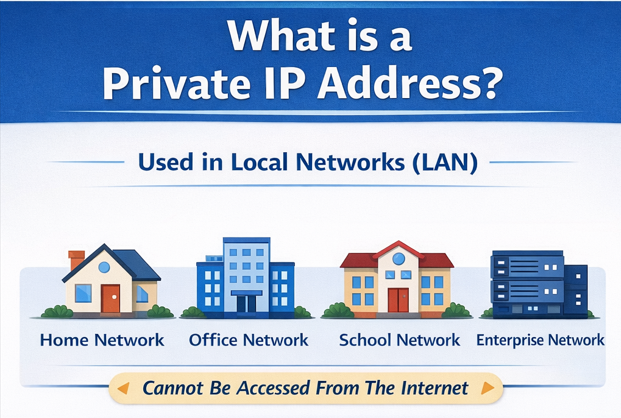
In virtually every home and enterprise environment, devices such as computers, smartphones, and servers are assigned private IP addresses from reserved ranges such as 192.168.x.x, 172.16.x.x, or 10.x.x.x. These addresses are intentionally non-routable on the public internet, meaning external systems cannot directly address or reach them.
When a device on the internal network initiates a request to the internet, the NAT-enabled router intercepts the outgoing packet and replaces the private source IP address with its own public IP address before forwarding it. It simultaneously records this mapping in a translation table. When the corresponding response arrives from the external server, the router consults this table, reverses the translation, and delivers the packet to the correct internal device — seamlessly and transparently.
NAT has become a cornerstone of modern networking for three principal reasons. First, it conserves the finite pool of IPv4 addresses by allowing hundreds or thousands of devices to share a single public IP. Second, it enhances network security by concealing the internal address structure from external parties, reducing the attack surface of private networks. Third, it provides flexibility in network design, allowing internal addressing schemes to be managed independently of public IP allocation.
What is Network Address Translation?
NAT stands for Network Address Translation. It is a networking technique that allows devices on a private network to communicate with the internet by translating their private IP addresses into a public IP address.
Why NAT is Important
- Conserving IPv4 Addresses.
- Enhancing Network Security.
- Enabling Multiple Devices to Share One Public IP.
- Simplifying Network Management.
- Supporting Network Transitions
How Network Address Translation Works
Network Address Translation is a process used by routers or firewalls to modify IP address information in network packets as they pass between a private network and the internet. NAT allows multiple devices inside a private network to communicate with external networks using one or more public IP addresses.
Network Address Translation mainly works by translating private IP addresses into public IP addresses and keeping track of these translations in a Network Address Translation table.
Step1 : Device sends a request
Your laptop at 192.168.1.10 wants to visit a website at 93.184.216.34. It sends a packet with its private IP as the source address and port 5050 as the source port.

Packet header: Source: 192.168.1.10 : 5050 → Destination: 93.184.216.34 : 80
Step2 : Router rewrites the source address
The NAT router intercepts the packet. It replaces the private source IP (192.168.1.10) with its own public IP (203.0.113.1) and assigns a unique port number (41000) to track this specific connection.
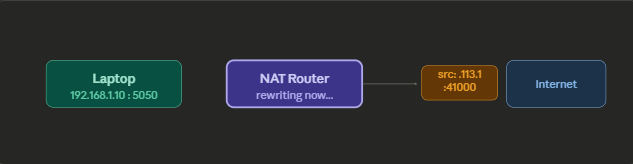
Packet header after rewrite: Source: 203.0.113.1 : 41000 → Destination: 93.184.216.34 : 80
Step3 : Router records the mapping
Before forwarding the packet, the router saves the mapping in its NAT translation table. This record is essential — it’s how the router will know where to send the reply when it comes back.
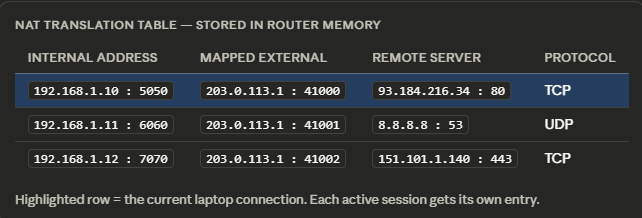
Step4 : Server sends a reply
The web server at 93.184.216.34 sends a reply back to 203.0.113.1:41000 — the router’s public IP. It has no knowledge of the private device behind it. The reply arrives at the router.
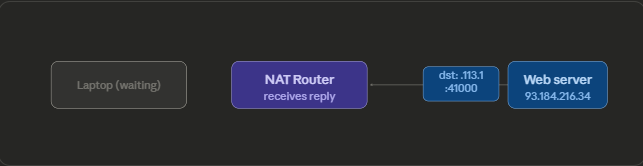
Reply packet header: Source: 93.184.216.34 : 80 → Destination: 203.0.113.1 : 41000
Step5 : Router delivers reply to the correct device
The router looks up port 41000 in its translation table, finds the original sender (192.168.1.10:5050), rewrites the destination address, and forwards the packet to the laptop. The entire process is invisible to both the device and the server.

Final packet header: Source: 93.184.216.34 : 80 → Destination: 192.168.1.10 : 5050
Laptop receives reply!dst: .1.10:5050NAT Router looked up table Web server
Types of Network Address Translation (NAT)
Network Address Translation (NAT) can be implemented in several ways depending on how IP addresses are mapped between private and public networks. The main types of NAT used in networking are Static NAT, Dynamic NAT, and Port Address Translation (PAT).
1. Static NAT
Static NAT creates a permanent, fixed mapping between a single private IP address and a single public IP address. The translation never changes — every time a specific internal device communicates with the internet, it always uses the same public IP.
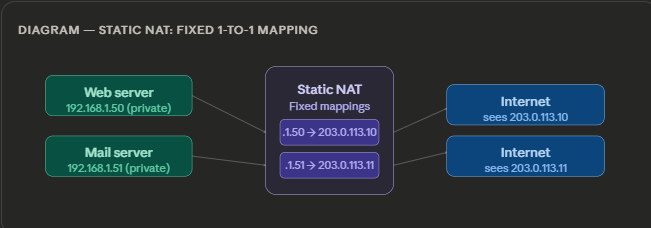
Use case: Hosting internal servers — web, mail, or FTP — that must be consistently reachable from the internet at a fixed public address.
Limitation: Requires one public IP per internal device. Costly and impractical at scale.
2. Dynamic NAT
Dynamic NAT maps private IP addresses to a pool of public IP addresses on demand. When an internal device initiates a connection, it is assigned an available public IP from the pool. Once the session ends, that public IP is released back for reuse.
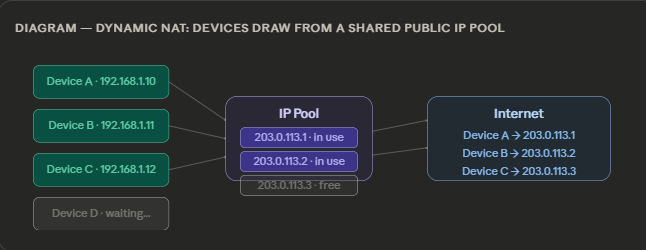
Use case: Organizations with a block of public IPs that want to distribute them dynamically across internal users.
Limitation: If all public IPs in the pool are in use, additional devices cannot connect until one is freed.
3. PAT (Port Address Translation)
PAT (Port Address Translation) allows multiple devices in a private network to share a single public IP address. It distinguishes sessions using port numbers.at
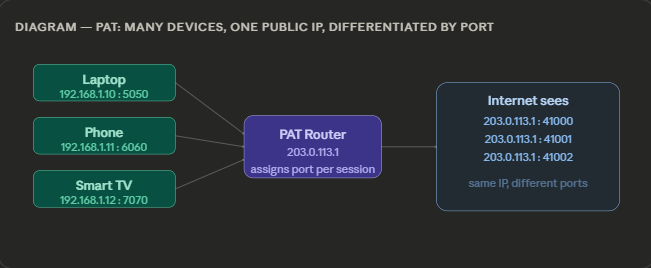
Use case: Home routers, office networks, and cloud NAT gateways — virtually any environment where many devices share one public IP.
4. Source NAT (SNAT)
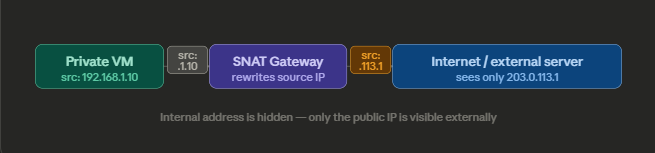
Source Network Address Translation (SNAT) is a type of Network Address Translation where the source IP address of a packet is modified when it leaves a network. SNAT is typically used when internal devices with private IP addresses need to communicate with external networks
Destination NAT (DNAT)
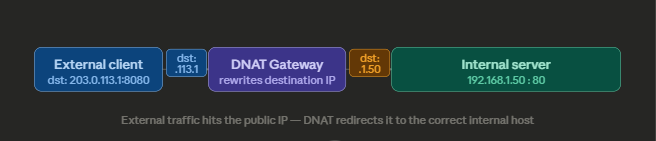
Destination Network Address Translation (DNAT) is a type of NAT where the destination IP address of a packet is changed as it passes through a router or firewall. DNAT is commonly used to allow external users on the internet to access internal servers located inside a private network.
Since internal servers often use private IP addresses that are not reachable from the internet, DNAT maps a public IP address to a private IP address so that incoming traffic can be forwarded to the correct internal host.


Leave a Reply